

 +38 (068) 400 - 00- 15


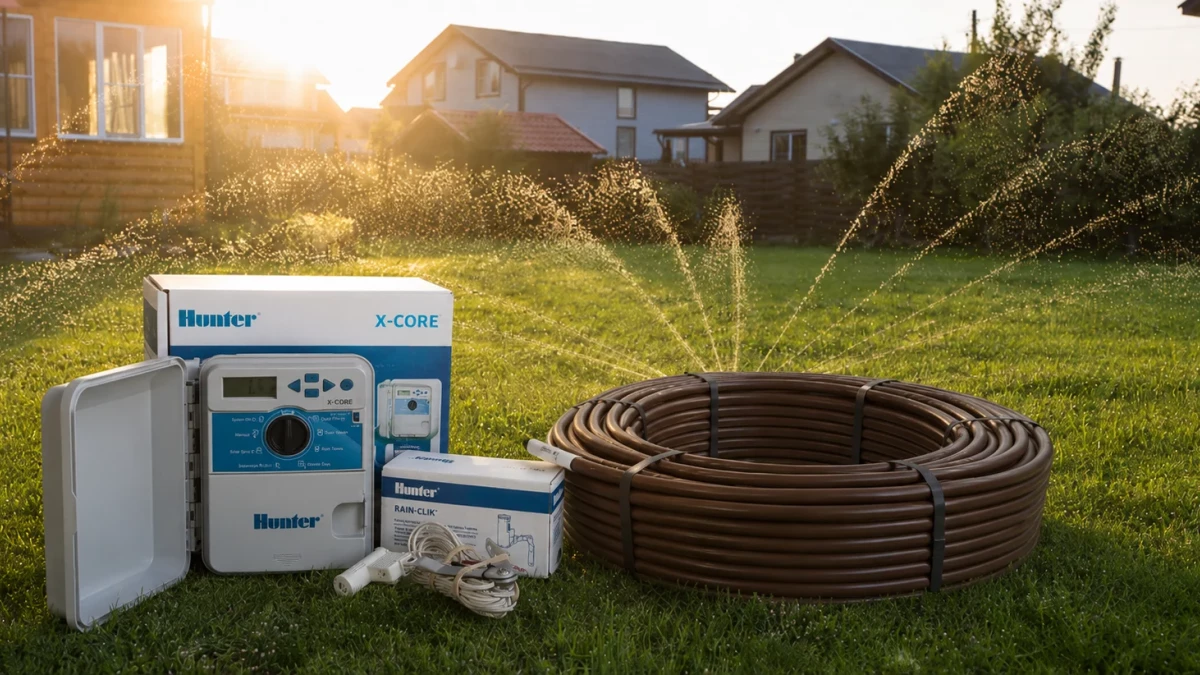

Automatic lawn irrigation is a convenient solution for a private plot, cottage or garden. The system itself turns on the irrigation at the right time, evenly moistens the lawn and helps to keep the grass green even in the heat.
Many plot owners think that only a specialist can install an automatic irrigation system. In fact, a simple automatic lawn irrigation system can be assembled with your own hands, if you properly prepare the scheme, select the equipment and do not rush with the installation.
What to start with automatic lawn irrigation
Before purchasing equipment, you need to understand three main things:
* what is the area of the lawn;
* where will the water be supplied from;
* What is the pressure and water flow rate in the system?
This is important because the pressure and amount of water depend on how many sprinklers can be connected to one zone. If you put too many sprinklers on one line, they will not extend normally or will not be able to irrigate the lawn evenly.
Draw a simple plot scheme
To start, draw a lawn plan on paper. You don't have to make a professional drawing. It is enough to indicate:
* the shape of the lawn;
* the length and width of the plot;
* the place of water connection;
* paths, flowerbeds, trees, house or fence;
* the place where you can install the controller and valves.
After that, you can approximately place the sprinklers. It is important that the water covers the entire lawn area without dry spots.
What elements are needed for automatic lawn irrigation
For the installation of an automatic lawn irrigation system with your own hands, you usually need:
* a pipe for water supply;
* fittings for connecting pipes;
* sprinklers or rotors;
* nozzles for sprinklers;
* electromagnetic valves;
* automatic irrigation controller;
* filter;
* valve box;
* starter connectors, elbows, tees;
* cable for valve connection;
* rain sensor if necessary.
For a small lawn, you can make a simple system with 1-2 zones. For a large plot, it is better to divide the irrigation into several zones so that the system works stably.
How to properly place sprinklers
Sprinklers should be placed so that the water jets overlap each other. This helps to avoid dry spots on the lawn.
Most often, sprinklers are placed:
* at the corners of the lawn;
* along the edges of the plot;
* in the central part, if the area is large;
* Near paths and fences, taking into account the irrigation angle.
For narrow plots, you can use nozzles with a smaller radius. For larger areas, rotors or sprinklers with a larger irrigation sector are suitable. Why is it important to divide the system into zones
One of the most common mistakes is to connect all sprinklers to one line. This can lead to a lack of pressure, and the system will not work properly.
It is better to divide the lawn into separate zones. Each zone is turned on separately through an electromagnetic valve. The controller opens the necessary valve at a given time, and water is supplied only to this part of the plot.
Thus, the system works more stably, and the lawn receives even irrigation.
Controller for automatic irrigation
The controller is a device that controls the entire system. It allows you to configure:
* irrigation start time;
* irrigation duration;
* days of the week;
* separate zones;
* seasonal settings.
For a simple automatic lawn irrigation system, you can choose a basic controller. For more convenient control, you can use models with Wi-Fi or the ability to connect a rain sensor.
Filter and system protection
A filter is needed to protect sprinklers, nozzles, and valves from sand, rust, and small particles in the water. Even if the water seems clean, there may be contamination in the system that gradually clogs the equipment.
It is also important to correctly select the pressure. If the pressure is too high, the system may work unstable or damage the connections. If the pressure is low, the sprinklers will not irrigate the lawn properly.
Main stages of installation with your own hands
The installation of an automatic lawn irrigation system can be performed in stages:
1. Make a plot scheme.
2. Divide the lawn into zones.
3. Select sprinklers, pipes, valves, and a controller.
4. Mark the places for installing sprinklers.
5. Lay the pipes.
6. Connect the fittings and sprinklers.
7. Install valves and a controller.
8. Check the system under pressure.
9. Configure the irrigation schedule.
Before covering the pipes with earth, it is necessary to check all connections. If there are leaks or low pressure, it is better to fix this immediately.
Typical mistakes when installing with your own hands
When installing an automatic irrigation system with your own hands, the following mistakes are often made:
* there is no scheme before installation;
* the pipe diameter is incorrectly selected;
* there are too many sprinklers in one zone;
* there is no filter;
* the nozzles are incorrectly selected;
* the sprinklers do not overlap each other;
* there is no pressure reserve;
* the valves are installed in an inconvenient place;
* The controller is selected without a reserve of zones.
To avoid these problems, it is better to make a list of equipment in advance and check the compatibility of all elements.
What can be bought for automatic irrigation in Agras
In the Agras online store, you can select components for an automatic lawn irrigation system:
* irrigation controllers;
* electromagnetic valves;
* sprinklers;
* nozzles;
* rotors;
* pipes;
* fittings;
* filters;
* accessories for installation;
* Hunter equipment and other components for irrigation systems.
If you don't know what products are needed for your lawn, you can prepare the dimensions of the area, a photo or a simple scheme - this will help to quickly find the right solution.
Conclusion
Automatic lawn irrigation with your own hands is a real task, if you prepare correctly. The most important thing is to make a scheme, divide the system into zones, select sprinklers, pipes, valves, a filter and a controller.
A competently assembled automatic irrigation system saves time, evenly waters the lawn and helps to keep the area green and well-groomed throughout the season.


Comments
There are no comments yet.
Leave a comment